Move object
Click or tap. No dragging needed.
Learning
The source can disagree with itself.
A traceable plan makes a contradiction visible before it becomes a course. Human review belongs in the generation flow.
Tomás Garbarino / Case studies
Opening
the case.
Loading the case study…
Case file 02 / Flock I+D
From scattered documents to evidence of competence.
At Flock I+D, I work on product flow, frontend and AI integration for Trainly’s learning and conversational assessment workflows.
Click or tap. No dragging needed.
01 / The challenge
Corporate learning often stops at delivery: a person receives a document, attends a session or completes a course. The organization still needs to know whether that knowledge can be explained or applied.
Operational knowledge is scattered across PDFs, manuals and processes.
Building and updating courses manually makes training slow to scale.
Attendance and multiple-choice scores reveal little about real reasoning.
Managers lack a clear view of understanding and knowledge gaps.
Click or tap. No dragging needed.
The product bet
What if existing company knowledge could become structured training—and understanding could be tested in conversation?
My contribution
My scope spans product flow, frontend and AI integration: connecting the learning experience with AI-powered workflows.
The team built the initial platform, document import and oral assessment. My work includes source handling, the reviewable plan, narration, learning progression and the manager’s action center. These captures show the actual application in a local demo with fictional data.
02 / The product loop
The value comes from connecting content generation, individual learning, conversational assessment and team visibility.
Click or tap. No dragging needed.
Source / inside the loop
Upload manuals, procedures and existing operational knowledge.
The source material gives the training its context: the processes and knowledge a team actually needs.
Manuals / procedures / documentsStage 1 of 5: Source. Start with what the company knows.
Upload manuals, procedures and existing operational knowledge. The source material gives the training its context: the processes and knowledge a team actually needs.
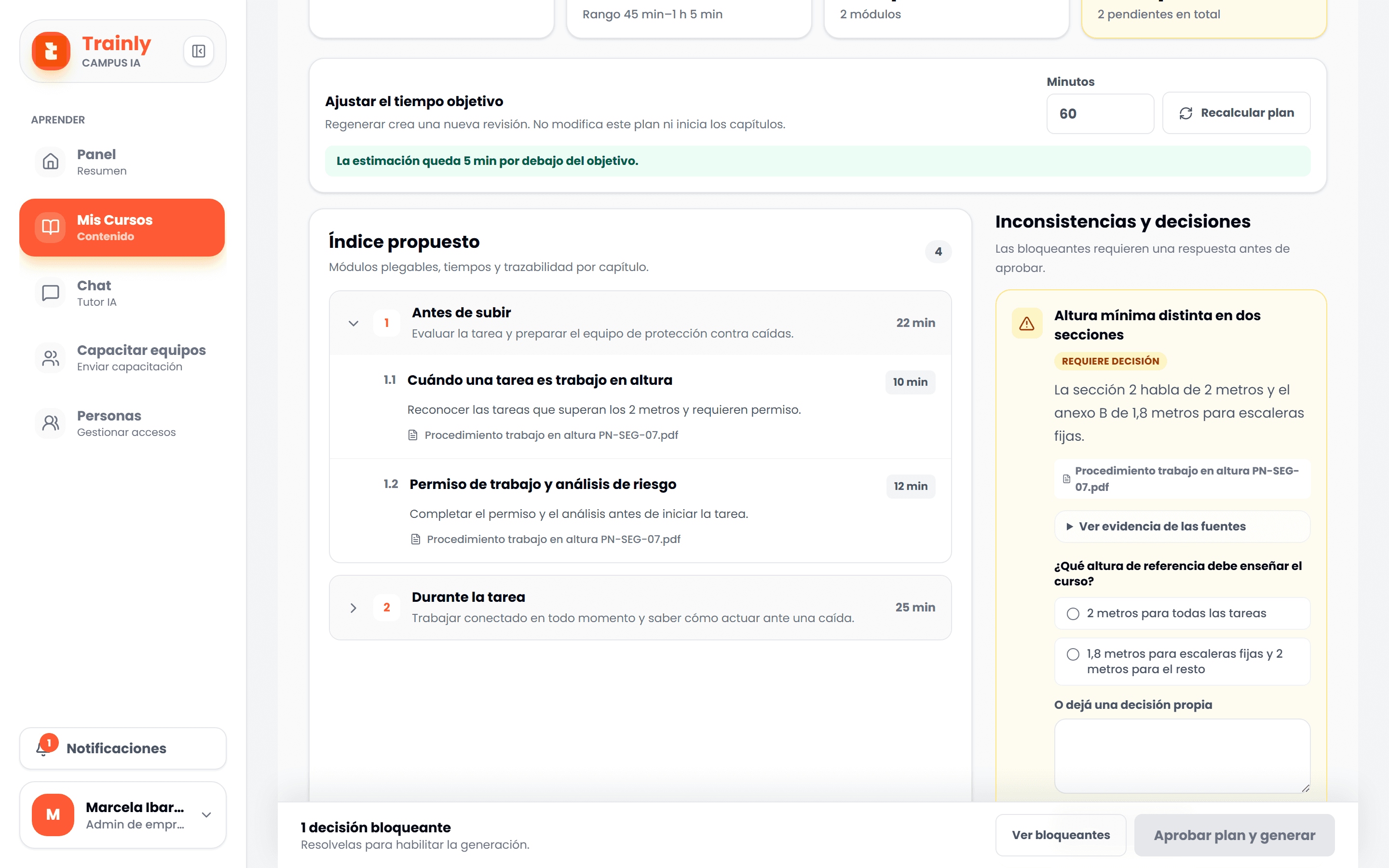
The AI proposes chapters with references back to the source material. Conflicting sources create a blocking decision. The training owner resolves it before approving the plan and generating the course.
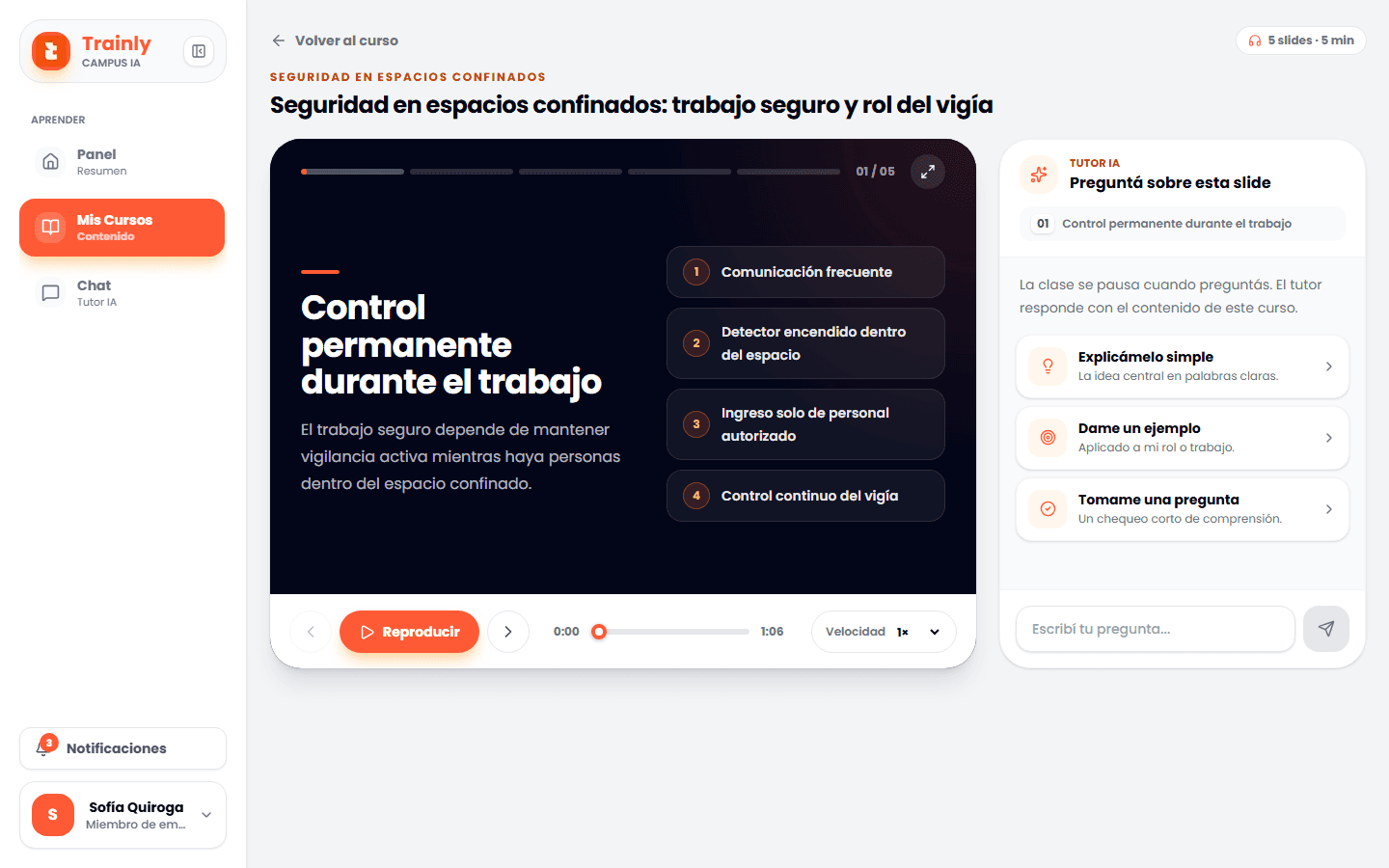
Chapters, visuals, quizzes and flashcards support the learning path. Narrated lessons pair the current slide with a contextual tutor. Learners can ask for an explanation, an example or a practice question.
A live AI interview explores how the learner explains and applies the material. The evaluator asks technical questions, requests examples and follows the reasoning behind an answer.
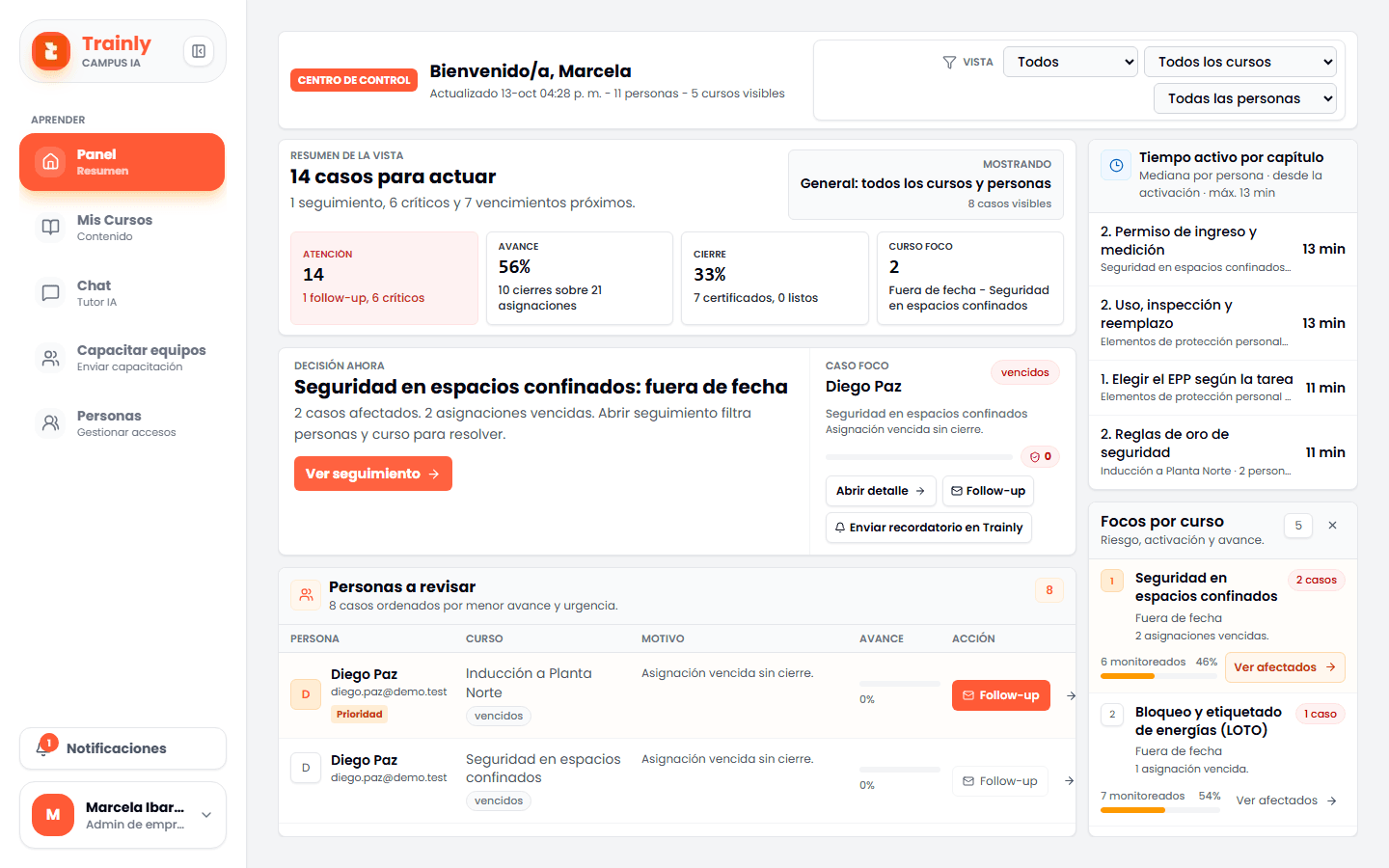
Progress and overdue assignments become cases to act on. The manager can inspect a priority case, follow up or send a reminder, with active study time alongside the learning progress.
03 / Learning experience
Generating a course is easy. Keeping it faithful to the source is the harder product problem. I worked on a reviewable plan that traces chapters to the source material and blocks generation when a contradiction needs a person’s decision.
Here, two sections disagree about a height threshold. The training owner must resolve that conflict before approving the plan. The AI proposes the structure; the person owns the decision.
Click or tap. No dragging needed.
Click or tap. No dragging needed.
One path / multiple formats
After review, the same material becomes a learning path. I worked on narration, source context and presentations by level. In the lesson, a learner can pause to ask the tutor for an explanation, an example or a practice question tied to the current slide.
Click or tap. No dragging needed.
04 / Practice & assessment
Quizzes give the learner a practice check. Conversational assessment follows a separate path: technical questions, concrete examples and follow-up on the learner’s reasoning.
Click or tap. No dragging needed.
Live AI interview / product approach
Technical questions. Concrete examples. Follow-up on the reasoning.
Click or tap. No dragging needed.
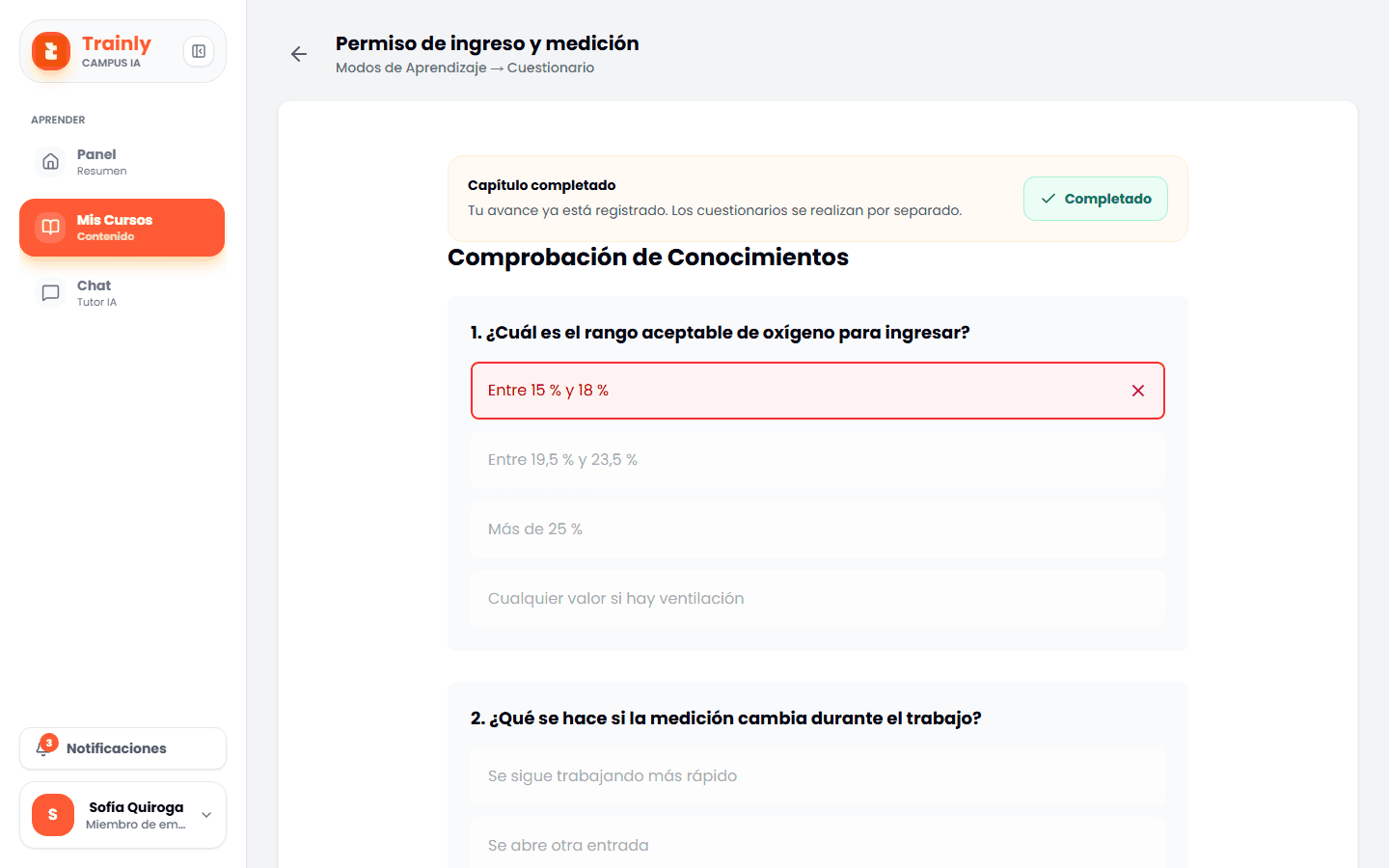
The quiz surfaced an improvement opportunity: it marks an incorrect answer, but does not yet explain it or reveal the correct one. A useful feedback loop needs to help the learner recover, not just record the mistake.
05 / The product system
A dashboard needs to lead to action. I worked on the manager’s center so it surfaces overdue training, a priority case and follow-up or reminder actions alongside progress and active study time.
Click or tap. No dragging needed.
System responsibilities
Click or tap. No dragging needed.
Click or tap. No dragging needed.
Click or tap. No dragging needed.
Click or tap. No dragging needed.
06 / Learnings & next
Training becomes more useful when teaching, evaluating and improving are designed as one connected system.
Click or tap. No dragging needed.
Learning
A traceable plan makes a contradiction visible before it becomes a course. Human review belongs in the generation flow.
Click or tap. No dragging needed.
Learning
A priority case with follow-up or reminder actions gives the manager a concrete way to help a learner.
Click or tap. No dragging needed.
Next
Quiz feedback currently marks an incorrect answer without explaining it. Clear recovery guidance is the next opportunity.
Click or tap. No dragging needed.
Next
Use real questions and a source-grounded evaluation set to check retrieval before deciding that a different model is the answer.
Click or tap. No dragging needed.
Current status / in use and growing
Clients use Trainly, and the product continues to grow. Explore the product flow, interface and implementation.